General aviation
National Championship Air Races Return To Roswell For Second Year
Following a successful inaugural event, the National Championship Air Races completed their second year at Roswell Air Center in New Mexico, drawing crowds and pilots across seven pylon classes and STOL Drag competitions.
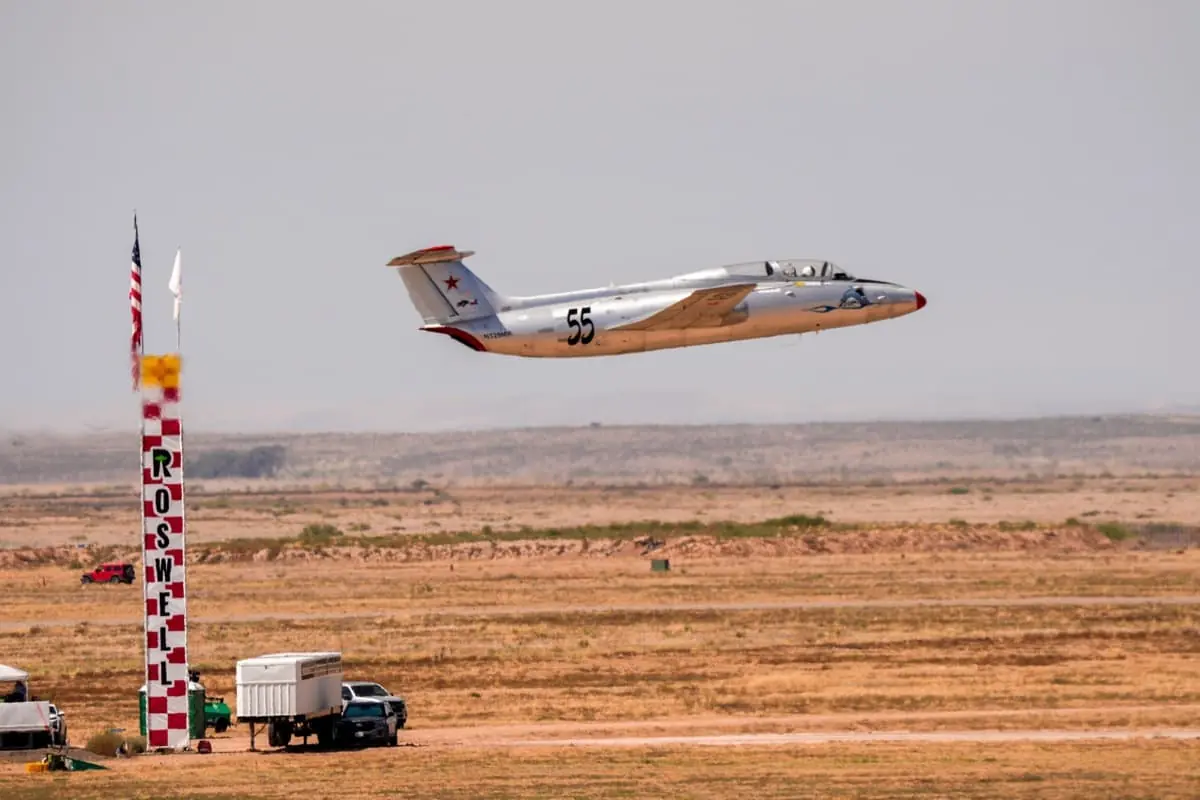
The multi-day gathering ran from September 16 to 20, expanding significantly over the previous year after relocating from Reno-Stead Airport in Nevada where it had been held for 63 years. More than 67 different airplanes competed across all racing categories alongside 14 pilots participating in STOL Drag races. Organizers incorporated an alien theme that drew enthusiastic responses from attendees, veterans of the event, and first-time visitors alike.
In addition to the pylon competitions, the schedule featured an air show and static displays. Spectators viewed military aircraft such as a C-17 Globemaster II, a B-52 Stratofortress, two T-38 fighter trainers, and the B-24 Liberator known as Diamond Lil, along with two Beech C-45s, a Spitfire recreation, and historic racing planes. Various commercial vendors and local organizations, including the New Mexico Pilots Association, set up booths during the week.
Twelve competitors entered the Formula One category using single-occupant machines built to strict technical standards and propelled by modified versions of the Continental O-200 engine. Trent Woodworth, a multiyear competitor, explained that his Cassutt utilizes a fixed-pitch 55-inch by 62° propeller spinning up to 3,700 rpm to generate approximately 150 horsepower compared to the engine's standard output of 100 horsepower. The aircraft cross the fence at 100 mph, touch down around 90 mph, and subject pilots to forces frequently reaching 3 Gs or higher. Josh Watson secured the Formula One Gold championship in his Gilbert DG2 named Fraed Naught with a speed of 250.404 mph.
Eleven entrants flew various configurations of the Pitts biplane in the Biplane division, where stock power plants deliver about 180 horsepower and race variants approach 225 horsepower. Tom Marden claimed the Biplane Gold victory piloting his Pitts S-1C designated Second Hand at 221.106 mph. Meanwhile, the Sport class featured 15 heavily modified homebuilt designs, primarily Lancairs and Glasairs alongside a few RV models utilizing advanced technologies such as nitrous oxide injection. Tom McNerney captured the Sport Gold win in his Lancair Legacy titled Too Much at 349.112 mph.
Seven vintage military trainers participated in the T-6/SNJ division, where Lee Oman took the gold trophy at 233.179 mph in an AT-6C named Miss TNT. The Jet class comprised five Aero Vochodny L-29 Delfins and five L-39 Albatros aircraft built in Czechoslovakia, with Jason Googe winning the Gold heat at 495.908 mph in a modified L-29 designated ArcAngel.
After sitting out the previous year due to safety concerns regarding the new venue's layout, power lines, and emergency landing options, the Unlimited class returned with eleven P-51 Mustangs, a Hawker Sea Fury TMK 20, and a Yakovlev 3UR-2000. Steven Coutches piloted a rare P-51H variant named 43, driven by a Rolls-Royce Packard V-1650-9 Merlin engine that reached 340 mph. Coutches spent seven years restoring the aircraft with his father, keeping its original military paint scheme rather than applying bright racing colors. Steven Hinton Jr. secured the fastest Unlimited Gold run by averaging 432.897 mph over six laps in the P-51D Bardahl Special.
Sources: General Aviation News, AOPA