Cessna
NTSB Final Report Cites Misfueling in Kentucky Cessna 421 Crash
An accident involving a Cessna 421 in Kentucky was caused by misfueling and a rushed preflight process, according to final reports from the National Transportation Safety Board.
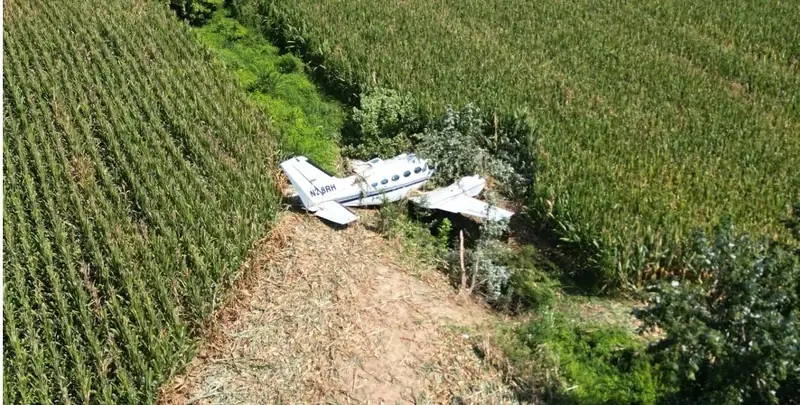
The National Transportation Safety Board has concluded its investigation into the August accident involving a Cessna 421 near Fulton, Kentucky. According to reports, the flight departed from Blytheville, Arkansas, on August 21, heading to Lima, Ohio, under instrument flight rules. Shortly after becoming airborne, the right engine experienced high cylinder temperatures on the No. 1 cylinder.
The pilot leveled the aircraft at 5,000 feet, but as the issue persisted, the decision was made to shut down and feather the right engine. Soon after, the remaining engine began failing, preventing the aircraft from maintaining altitude. The pilot attempted to reach an airport but ultimately performed a forced landing in a cornfield roughly two miles away.
Two occupants sustained serious injuries, while two others suffered minor injuries. The airframe suffered substantial damage to the fuselage, empennage, and right engine mount. Subsequent investigations revealed that the aircraft had received 145 gallons of Jet-A instead of aviation gasoline before departure.
Interviews conducted during the investigation indicated that the line worker added approximately 75 gallons to the left wing and roughly 70 gallons to the right wing after being asked simply to top off the aircraft. The fueler assumed Jet-A was required because pilots needing 100LL typically utilized a nearby self-service pump. The pilot stated that no specific fuel type was requested, and although the fuel receipt indicated Jet-A had been pumped, the occupants were in a hurry and departed without checking or sampling the fuel.
The National Transportation Safety Board determined that the primary cause of the accident was the refueling error by the line worker, with the pilot's omission of a pre-departure fuel check noted as a contributing factor. Following the incident, the airport manager reported that the individual involved is no longer employed at the facility, and the airport has introduced a new form requiring pilots to explicitly state their desired fuel type and quantity.